

- Published:
- Tuesday 7 April 2026 at 11:00 am
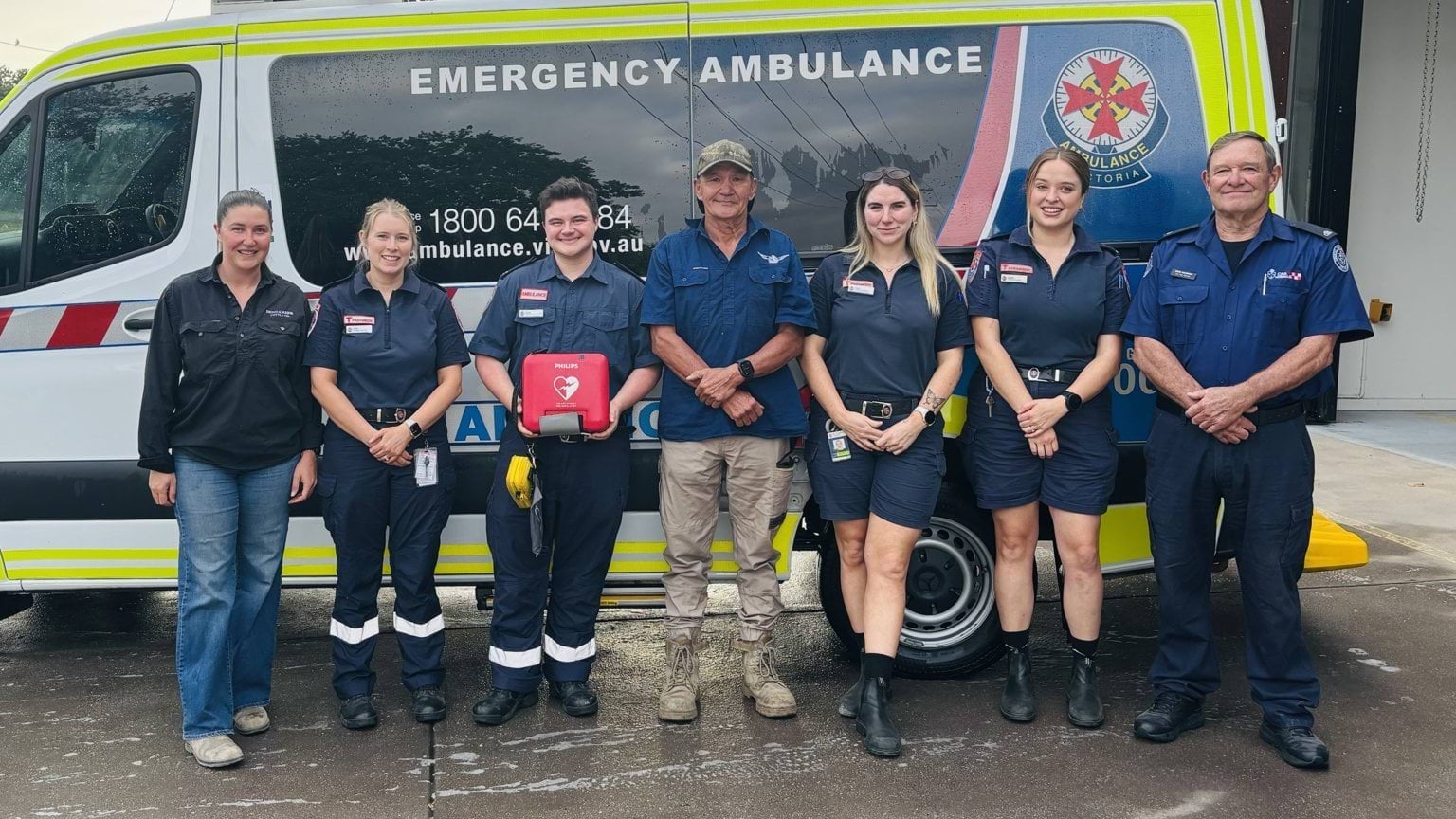
When Yea residents were told the Longwood bushfire was close to their township in January, resident Ron Murnane didn’t hesitate to help his friends prepare their farm. But he never thought his cardiac arrest would be the reason Country Fire Authority (CFA) firefighters and Ambulance Victoria (AV) paramedics attended the property.
On 9 January, Ron (63) was sitting outside when he collapsed and became unresponsive.
Thankfully, his friends provided immediate intervention, calling Triple Zero (000) and splitting up so some could head into town to locate an Automated External Defibrillator (AED) while the others took turns to perform effective cardiopulmonary resuscitation (CPR).
It wasn’t long before AV Ambulance Community Officer (ACO) and CFA firefighter Corey Bennett received an alert through the GoodSAM app, which connects patients in cardiac arrest with a nearby volunteer who is willing to start hands-only CPR while an ambulance is on the way.
“I live very close to where it happened and had returned home to get some rest after responding to the fires when the alert came through,” Corey said.
“Because of my role in the CFA I knew the direction the fire was headed and how far away it was from that area of town. I felt safe responding and knew there was someone out there who needed immediate help, so I headed straight over.”
ACOs are AV first responders trained to provide advanced first aid in rural and remote communities where the ambulance caseload is low or the ambulance branch is not staffed by multiple paramedics on a full-time basis.
ACOs are employed on a casual basis to work ‘on call’ and can transport patients to hospital. They play a vital role in community healthcare, making a big difference to their patients’ life and health outcomes.
Fellow CFA volunteer Steven McConnell was at the Yea CFA station when he came across a car of people searching for an AED.
“It was quicker for me grab the AED and hop in their vehicle than it was for me to get the response truck out, so that’s what we did,” Steven said.
“When we got back to the house, they were doing CPR and all of them did a great job. They kept Ron going until we got there with the defib.”
Ron’s two friends, Brittany Mitchell and Brett Styles, alternated giving CPR, with Corey and Steve helping to administer four shocks from the AED, achieving return of spontaneous circulation (ROSC) before paramedics arrived.
The constantly evolving fire conditions were being closely monitored by AV staff based in the Incident Control Centre in Alexandra, who were then able to inform the dispatched paramedic crews how to safely access the property.
ALS and Mobile Intensive Care Ambulance (MICA) paramedics assessed Ron and determined he had experienced an ST-segment elevation myocardial infarction (STEMI), a major heart attack which can lead to cardiac arrest if untreated.
The paramedics thrombolysed Ron using a specialised clot-busting drug called tenecteplase, which is used to treat patients who are experiencing a STEMI but are more than 90 minutes from the nearest hospital with specialist cardiac facilities.
AV Advanced Life Support (ALS) paramedic Kate Borzym was one of the attending crews and said the bystanders’ efforts gave Ron the best chance of both survival and making a good recovery.
“For someone to be as alert and oriented as Ron was post-cardiac arrest is unbelievable. I have never seen that happen before from bystander intervention. It really just shows what an incredible job everyone did,” she said.
Brittany Mitchell, who was one of the friends who gave Ron CPR, said it was incredible to have helped save a life.
“It’s the first time I’ve ever done CPR on someone, and it was really confronting. But Ron has a second chance at life now. Every person played their part and it’s amazing that he’s still here today,” she said.
You don’t have to be first-aid qualified or have a medical background to help save a life. To be a GoodSAM responder, you just need to be willing and able to do hands-only CPR, be over 18 years of age and have access to a smartphone.
More information on GoodSAM.
Updated