

- Published:
- Thursday 9 July 2026 at 2:00 pm
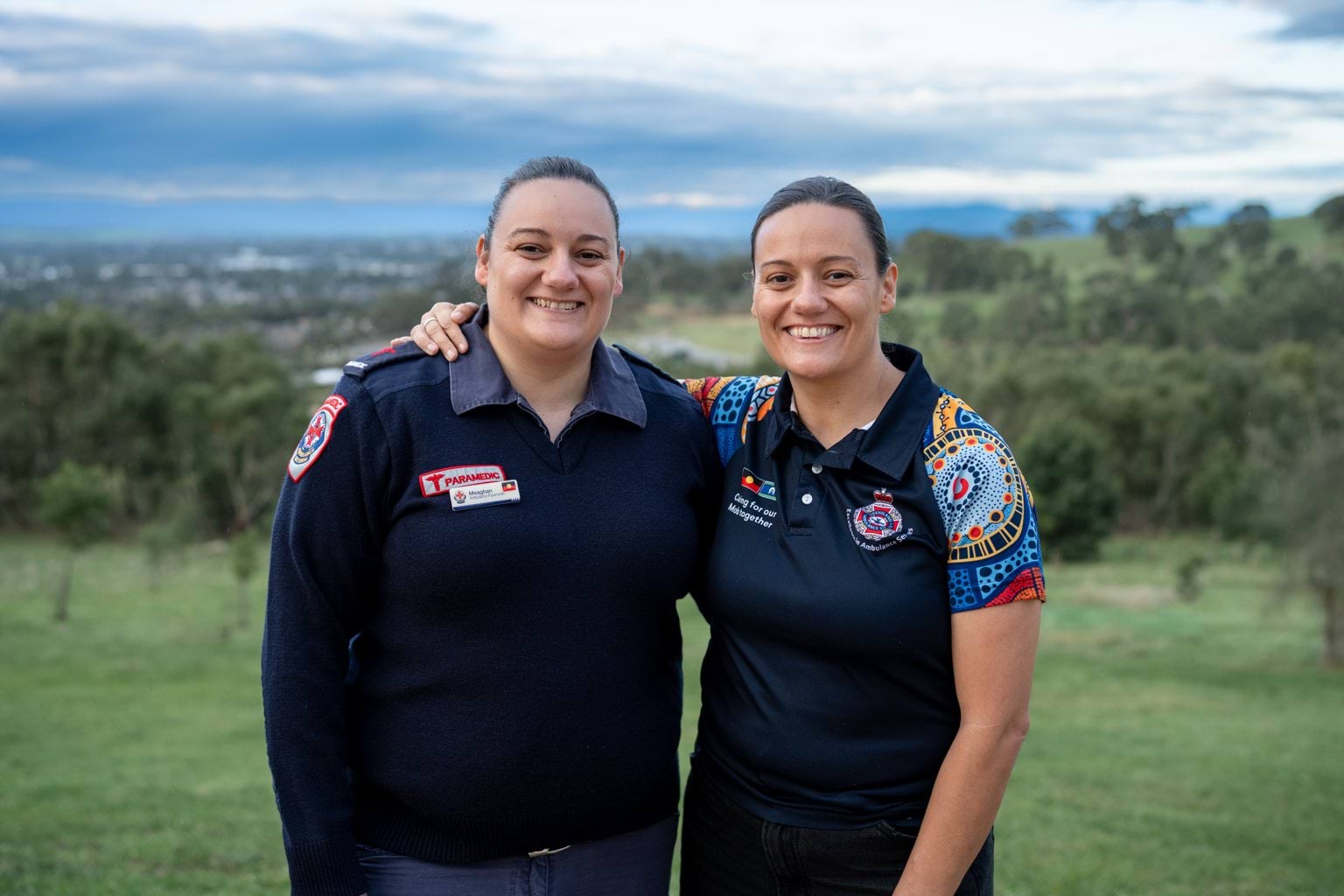
For twins Meaghan and Lauren Clayton, caring for others isn’t just part of the job, it’s who they are.
Raised in a family grounded in community, responsibility, service and belonging, the sisters were inspired by their Indigenous heritage and proud Kaurna ancestorial ties.
Those values didn’t just shape their childhood, they set them on a shared path into paramedicine and continue to drive their work today with Ambulance Victoria and the Queensland Ambulance Service.
Both qualified paramedics, Meaghan and Lauren have seen firsthand the challenges facing Aboriginal and Torres Strait Islander communities over their more than 15 years of frontline experience – igniting a desire to make meaningful change.
For Meaghan, joining Ambulance Victoria’s Reconciliation Working Group (RWG) allows her to oversee, with her colleagues, the implementation of the Innovate Reconciliation Action Plan (RAP) and continue to move the organisation towards being more culturally responsive.
“I am passionate about promoting and advancing a culturally safe and inclusive workplace here at Ambulance Victoria,” Meaghan said.
“I am excited that a focus of Ambulance Victoria's Innovate Reconciliation Action Plan is increasing Aboriginal and Torres Strait Islander recruitment, retention and professional development. I am pleased to know that through this action, Aboriginal and Torres Strait Islander staff will be culturally supported through their careers.
“Of course, there’s still more work to be done. I would like to see a supported education pathway for clinicians to move into leadership roles to allow for self-determination within the organisation as well.”
Meaghan is equally passionate about improving health outcomes for Aboriginal and Torres Strait Islander patients and this includes paramedics asking patients, where practical, if they identify as Aboriginal and/or Torres Strait Islander, and recording this information in their Patient Care Record.
“We ask all patients if they are of Aboriginal and/or Torres Strait Islander descent to identify potential vulnerabilities and health-related risk factors associated with cultural background. This allows paramedics to deliver the most appropriate healthcare options and referrals and improve health outcomes – delivering culturally safe and equitable healthcare,” Meaghan said.
“This is important, as Aboriginal and Torres Strait Islander peoples generally have poorer health outcomes than other Australians, as identified in Closing the Gap.
“While asking this question is relatively new in Victoria, it’s vital that clinicians and all Victorians understand the difference this question can make to the health outcomes of some people. A persons’ cultural background cannot be assumed by their appearance.”
Inspired by their shared experience of being the first in their family to complete secondary school and achieve tertiary education, Lauren’s goal has been to create pathways for Aboriginal and Torres Strait Islander people to enter the ambulance service. She is now a valued member of the Queensland Ambulance Service Aboriginal and Torres strait Islander Cultural Safety Unit.
“That experience shaped my understanding of how many barriers still exist for Aboriginal and Torres Strait Islander people who want to enter healthcare professions and showed me what is possible when those barriers are removed,” Lauren said.
“My role is about creating positive, measurable change both inside the organisation and across communities with a focus on improving health equity for Aboriginal and Torres Strait Islander peoples, embedding cultural safety, delivering culturally responsive care and building pathways for Indigenous representation and leadership.
“My commitment to health equity comes from wanting to create the systemic change that our family never had – ensuring that other First Nations people can achieve whatever role they aspire to within ambulance, whether that be a frontline paramedic, administrative support, or a leadership position.
“My work is driven by the belief that representation, cultural safety, education and equitable access are essential to improving health outcomes for our communities.”
The sisters’ passion for frontline service runs deep having grown up watching their grandfather, Guy, work as an Ambulance Officer in Launceston and their father, Rob, dedicate 40 years to aviation firefighting at Essendon and Melbourne Airports.
As twins, Meaghan and Lauren have completed many milestones together, including starting on road as patient transport officers in Melbourne.
It was in this role that both Meaghan and Lauren realised paramedicine was the perfect fit.
“That role was the first time I saw how the cultural values we were taught growing up translated into a professional role. I found real meaning in supporting people during vulnerable moments, and it made me realise I wanted to do more – to challenge myself and to take on a role where I could make a bigger difference,” Lauren said.
“My experiences working across northern and remote Queensland as part of the Queensland Ambulance Service Diploma program confirmed that becoming a paramedic wasn’t just a career choice, it was an extension of my cultural values, my identity, and my commitment to serving community in a meaningful way.”
Together, Lauren and Meaghan are not only saving lives – they’re reshaping the future of pre-hospital emergency healthcare, making it more inclusive, equitable, and culturally safe for generations to come.
This NAIDOC Week, Ambulance Victoria is proud to celebrate the rich and diverse cultures of our Aboriginal and Torres Strait Islander communities.
Updated