

- Published:
- Wednesday 10 December 2025 at 11:25 am
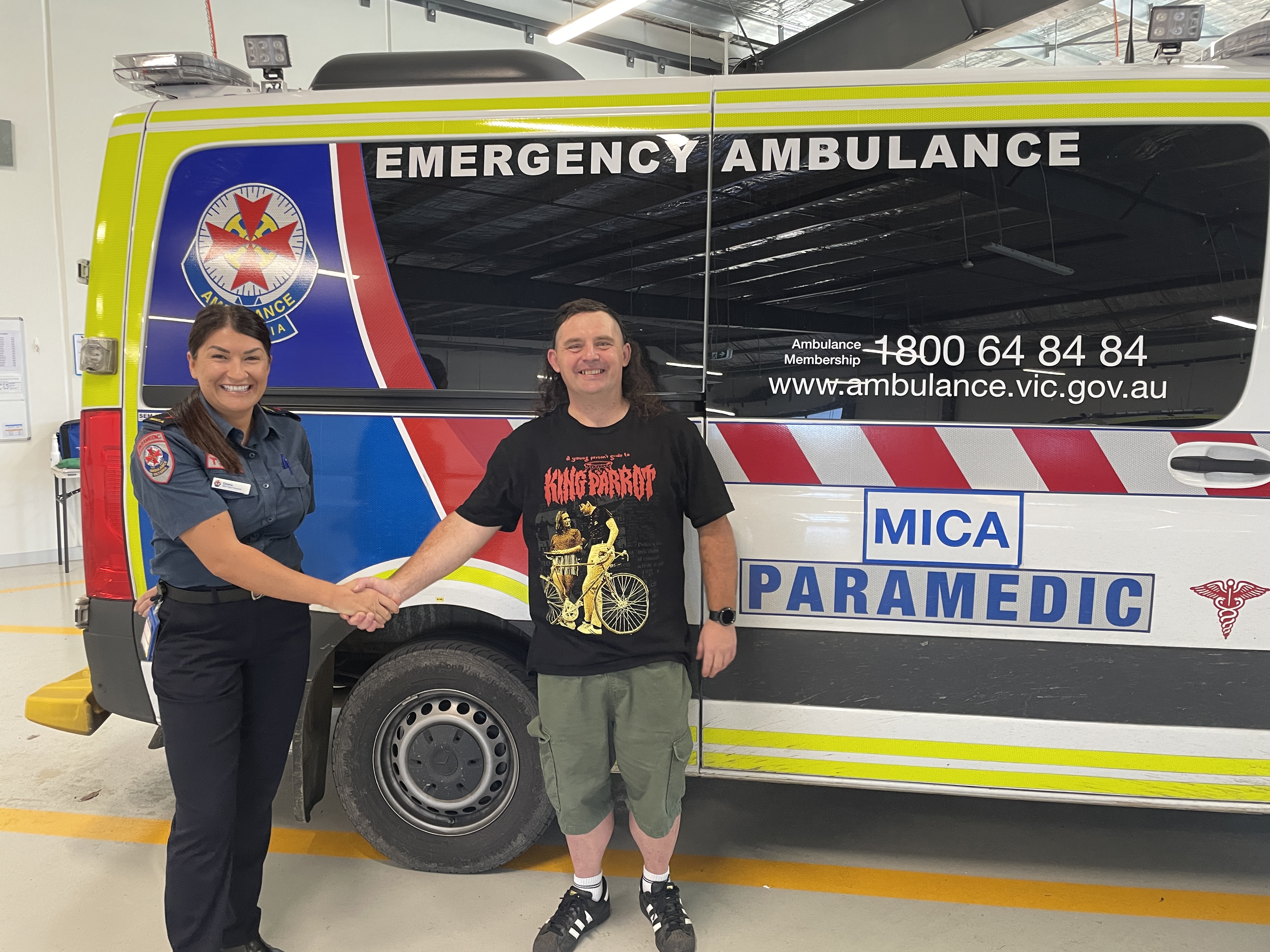
A Morwell man who survived a heart attack at just 39 years old has thanked the Ambulance Victoria (AV) paramedics who saved his life using a specialised medication only carried in rural ambulances.
Michael Soban began experiencing chest pain on a November evening in 2021. He went to bed, thinking it would disappear, but the pain only worsened and by morning, it was excruciating.
“I’d never experienced pains like that before. It was like a truck was parked on my chest and a forklift was bouncing up and down on the back of the truck,” he said.
Michael knew something wasn’t right and called Triple Zero (000).
Mobile Intensive Care Ambulance (MICA) paramedic Eleisha Albert said it was clear Michael was feeling distressed when she arrived, but she didn’t expect he was actually having a severe heart attack.
“He met us at the door and he was quite sweaty. I thought it was from the shower, but it turned out it was from a heart attack,” she said.
“We had put the cardiac monitor onto him and when the electrocardiogram (ECG) was printed out, I remember looking at it in disbelief. He was so young to be having a heart attack.”
Michael was experiencing an ST-segment elevation myocardial infarction (STEMI), a major heart attack often caused by a complete blockage to a major coronary artery.
Without prompt treatment, Michael was at risk of developing a heart arrythmia, chronic heart failure or going into cardiac arrest.
The AV ambulance that attended Michael carried a drug called tenecteplase, which is used by paramedics to treat patients specifically like Michael, who are experiencing a STEMI but are more than 90 minutes from the nearest hospital with specialist cardiac facilities.
Heart attack patients within 90 minutes of a hospital with specialist cardiac facilities are typically transported straight there for an angiogram and surgical intervention.
“Tenecteplase is a clot-busting drug, meaning it has the ability to dissolve blood clots in your arteries,” Eleisha explained.
“We discussed the treatment with Michael and decided it was the best option for him given the distance to hospital. We administered the medication at his home then loaded him into the ambulance and transported him to Monash Medical Centre in Clayton, providing him with additional pain relief on the way.”
Once at hospital, Michael received surgical intervention and had one stent inserted into an artery. It was discovered that the heart attack was caused by an underlying genetic disorder called familial hypercholesterolemia, which had caused his cholesterol levels to be extremely high – a reading of almost 14 mmol/L. Now, Michael’s levels are down to 3 mmol/L.
“I was an active person, I would do 100km and six-hour mountain bike races. I’d had chest pains before, but I always thought a little bit of pain was no big deal, a ‘no pain no gain’ attitude. I didn’t know I had any issues, but then I had a heart attack,” Michael said.
Four years on, Michael had the chance to say thank you to the paramedics who saved his life.
“They’ve forever got a place in my heart. I probably would have died if it wasn’t for them,” he said.
“I wanted to say thank you and let them know that I’m continuing on. Not to the extremes that I was once, but I’m making the most of what I’ve got.”
Eleisha said Michael’s story is a reminder to take chest pain seriously.
“If you have any concerns, follow up with your GP and make sure to get regular check-ups on your cholesterol, blood pressure and blood sugar levels,” she said.
“If you’re concerned, call an ambulance. Even if you’re 39 years old and think it could never happen to you.”
Symptoms of a heart attack can include pain in your chest, arm, shoulder, back, neck or jaw, as well as shortness of breath, dizziness, sweating, nausea or extreme fatigue.
Many risk factors of a heart attack can be reduced by lifestyle changes or medication. You can make an appointment with a GP to identify any risk factors you have and make a plan to manage them.
Updated