

- Published:
- Thursday 26 June 2025 at 9:00 am
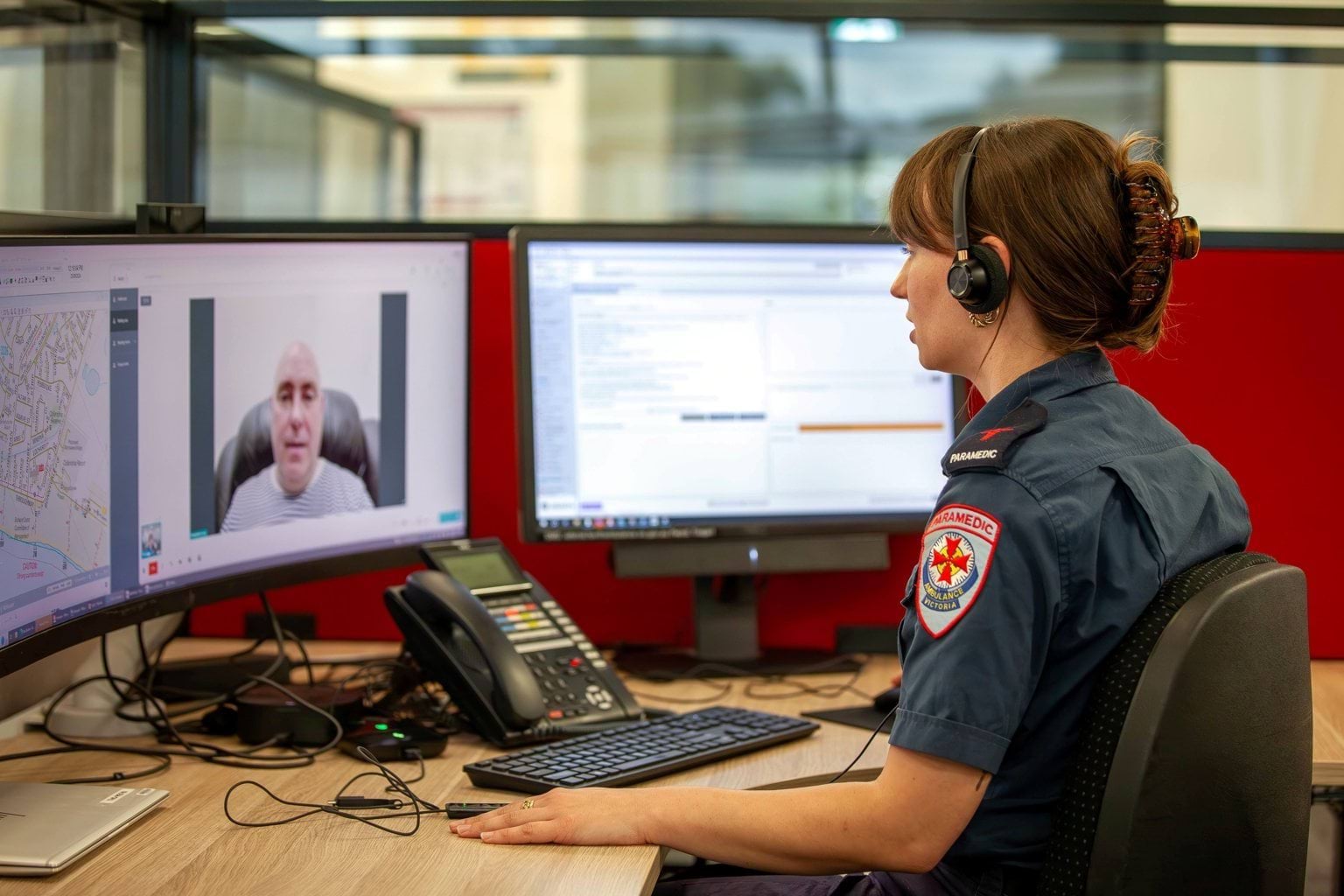
Ambulance Victoria’s (AV) groundbreaking video assisted triage (VAT) service has been helping save ambulances for emergencies for a full year.
The Australasian-first video technology allows AV’s Secondary Triage team to connect with non-urgent callers to Triple Zero (000) via video call, to better assess their condition and determine the best medical care for them.
AV Director of Operational Triage Services Diana Zimmermann said it gives triage practitioners a clearer picture of a patient’s condition.
“Being able to video call with patients and see their injury or see how sick they are is a game-changer, which helps us ensure each patient receives the right level of care,” she said.
“With a more accurate video assessment, we can often safely refer patients to more appropriate care options such as the Victorian Virtual Emergency Department (VVED) or their GP, freeing up ambulances for the most serious emergencies and saving patients a lengthy wait in a hospital emergency department.
“VAT also helps us recognise when a patient has understated their emergency, allowing us to upgrade the response and send an ambulance to them.”
VAT was first trialled from November 2023 to February 2024 before being formally implemented in April 2024. It is the first time video technology of its kind has been used in an Australasian ambulance service.
Over its first year of operation (17 April 2024 – 17 April 2025), more than 24,500 patients were assessed using VAT.
Of these, 63 per cent were assessed to not require an emergency ambulance, compared to 53 per cent when assessed with voice-only triage.
Diana said VAT is creating a better experience for patients, paramedics and triage practitioners.
“From the first trial, VAT made a huge, positive impact for our patients – 93.2 per cent of patients assessed during the trial said VAT improved their experience with AV,” she said.
“Our triage practitioners also had more confidence in decision-making and were able to establish better rapport with patients by speaking to them via video call.
“With the success of the technology so far, we’re now using VAT more. In the first month, three per cent of cases managed by Secondary Triage used VAT, now it’s 20 per cent and increasing.
“We want patients to get the right care, in the right place, at the right time – and that doesn’t always mean sending an emergency ambulance or attending an emergency department.”
About one in five calls to Triple Zero (000) do not need an emergency ambulance response.
As many as 900 calls a day are assessed by highly skilled registered nurses and paramedics in AV’s Secondary Triage team and provided alternative care options including:
- Non-emergency transport
- GPs and pharmacists
- The Victorian Virtual Emergency Department (VVED)
- Urgent Care Clinics
- Safely treating conditions at home
- Self-presenting at hospital.
Updated