

- Published:
- Monday 12 October 2026 at 4:00 pm
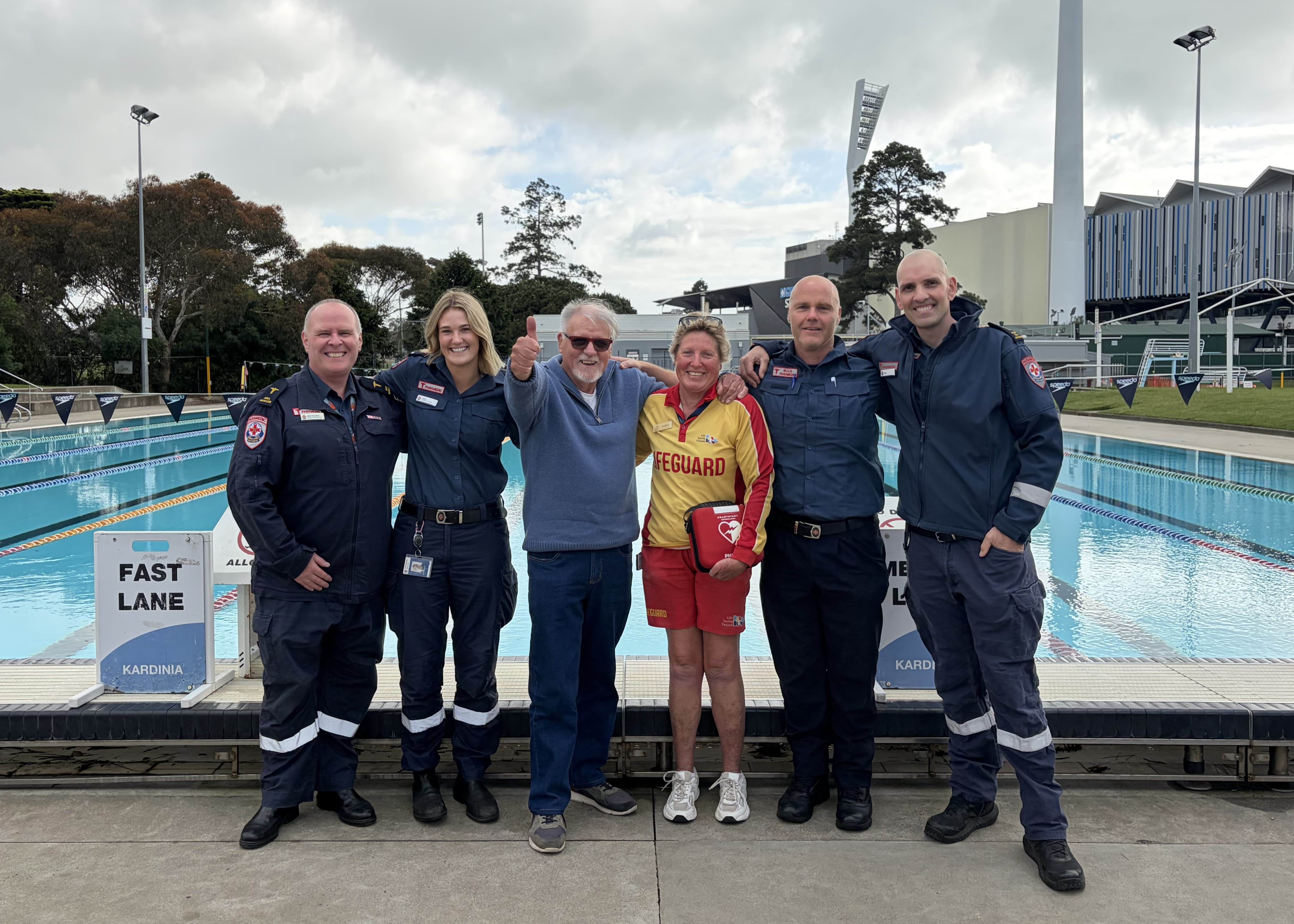
Only one in 10 cardiac arrest patients survive to tell the tale, but for one lucky Geelong man, quick and effective bystander intervention has helped save his life twice.
Bob Belle, 79, has gone into cardiac arrest on two occasions, once in June this year and once in 2023 – and his unusual story doesn’t end there.
Both times, his heart stopped when he was swimming at the City of Greater Geelong’s Kardinia Aquatic Centre on a Monday morning. Both times, the same fellow swimmer helped pull him out of the water. And incredibly, both times lifeguard Deb Seller began the critical first steps of the chain of survival to save his life.
As part of Ambulance Victoria’s Shocktober campaign, Bob and Deb are sharing their story to show the life-saving impact of starting cardiopulmonary resuscitation (CPR) and delivering a shock with an automated external defibrillator (AED) before paramedics arrive.
Bystander intervention has the biggest impact on improving survival from cardiac arrest. When patients receive CPR (chest compressions) and a shock from an AED before paramedics arrive, their chance of survival more than doubles.
That was exactly what Deb did when Bob’s heart stopped at the pool. On both occasions, another swimmer called out to her to let her know Bob was unresponsive and Deb knew every minute mattered.
“He was going blue and I knew he had a big problem. I thought I’m not stuffing around doing breaths, I’m just starting compressions to get the blood to his brain. He needs help now,” she said.
“When it happened again this year, I was just thinking, ‘I hope it’s not Bob’. I was more worried the second time – last time I didn’t know Bob’s name. This time, I was calling out to him, hoping he’d be able to hear my voice. I was saying, ‘come on Bob, wake up and tell me to piss off!’”
Deb used the Kardinia Aquatic Centre’s AED both times, delivering two shocks to Bob before Ambulance Victoria paramedics arrived.
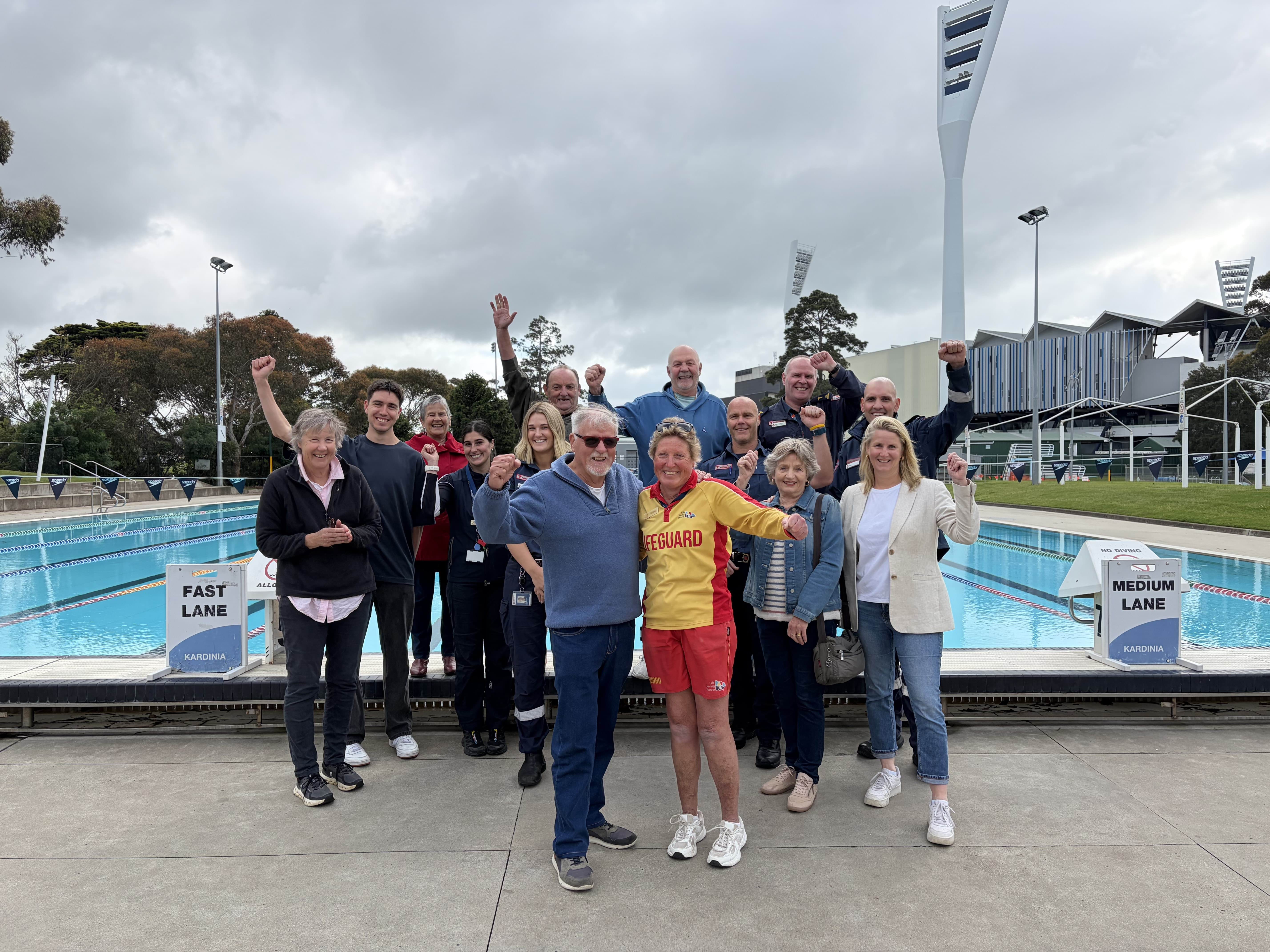
After further treatment from paramedics at the scene and treatment in hospital, Bob has survived and recovered. Within 10 weeks, he was back in the pool.
“I’m going extraordinarily well,” he said.
“I’m eternally grateful for what they all did, and Debbie particularly because she started it all. I’m in awe of everyone who played a part in saving my life. They are unbelievably good people.”
Deb has been a lifeguard for 41 years and has run lifeguard training, covering CPR and first aid, for about 30 years. Her message to everyone, even if you haven’t done CPR or AED training, is just give it a go.
“Unfortunately, not everyone is going to come back from having a cardiac arrest no matter how effective your action is – I’ve been lucky both times. But what I always tell people is just do your best and try. Give the patient a chance to survive,” she said.
For every minute without CPR, the chance of a cardiac arrest patient surviving decreases by 10 per cent.
Ambulance Victoria Senior Team Manager Greg Seiz was one of the paramedics who attended Bob’s cardiac arrest in June this year. He said Bob’s survival is testament to the power of early CPR and defibrillation, which is what Shocktober is all about.
“Our message to the community is that you don’t have to be a paramedic to help save a life,” Greg said.
“Anyone can by following the three simple steps: Call Triple Zero (000), Push hard and fast on the centre of the chest to give CPR and Shock using an AED to attempt to restart the heart.”
Updated